How Many Monkeys Can You See Here? A Fun Brain Teaser That’s Trickier Than It Looks
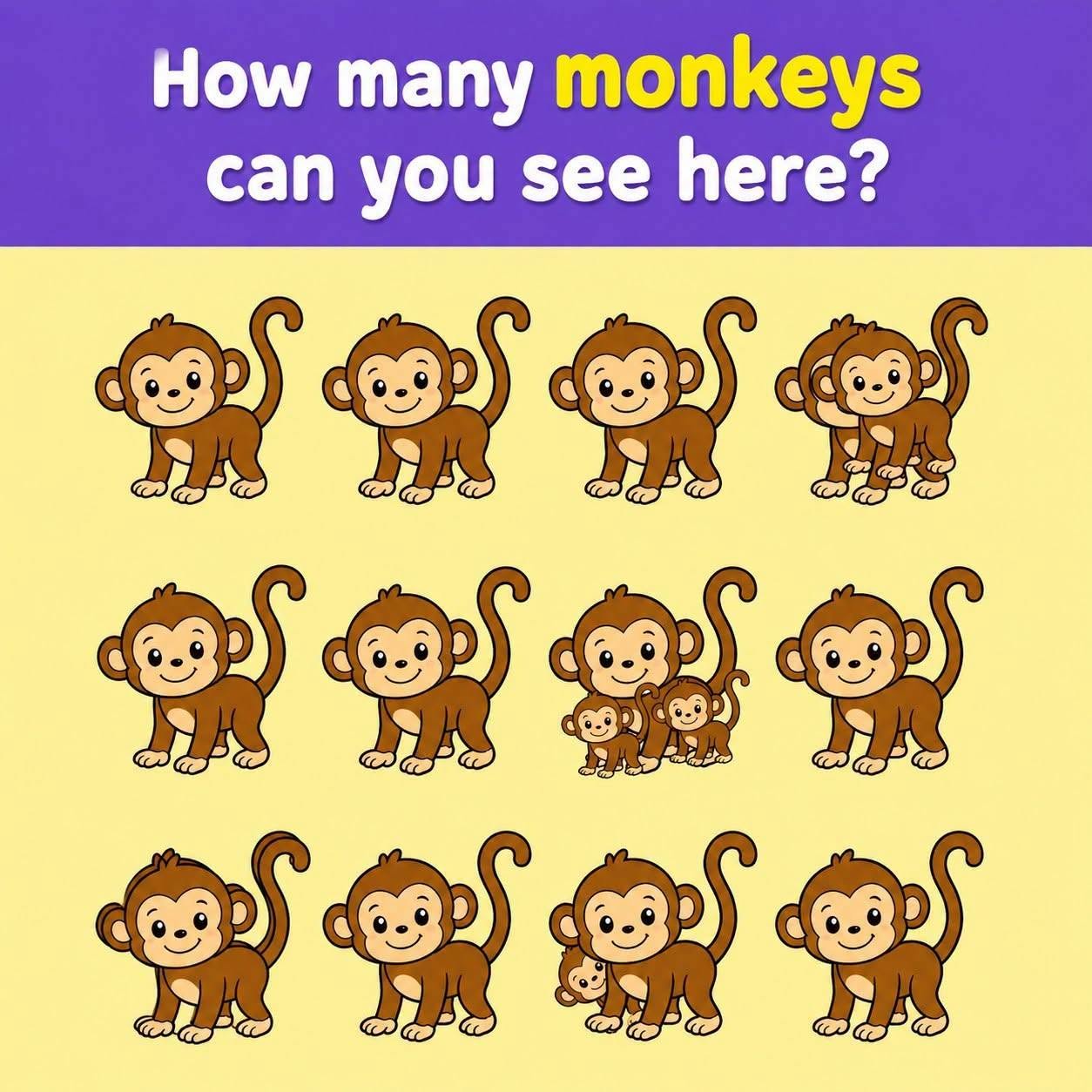
At first glance, this adorable monkey puzzle looks simple. You see a grid of cartoon monkeys smiling back at you, and the question seems easy:
“How many monkeys can you see here?”
But don’t be fooled — this is one of those visual brain teasers designed to test your observation skills, attention to detail, and ability to spot hidden objects. Many people quickly answer with the obvious number and miss the cleverly concealed monkeys hiding in plain sight.
So before you scroll down for the explanation, take another close look at the image and count carefully.
Why Brain Teasers Like This Are So Popular
Visual puzzles and “spot the hidden object” challenges have become hugely popular on social media for a reason: they’re fun, engaging, and surprisingly satisfying. They make us pause for a moment in the middle of our busy day and focus on something playful.
These puzzles work because they challenge:
-
Selective attention – our brain focuses on the most obvious elements first.
-
Pattern recognition – we naturally group similar objects together.
-
Visual perception – hidden details can blend into the background or overlap with larger images.
-
Patience and concentration – the longer you look, the more details you notice.
Psychologists often use similar tests to study how the human brain processes visual information. Our minds are efficient, but that efficiency can sometimes make us overlook small details.
The Obvious Count vs. the Real Count
The obvious count
If you count only the large monkeys arranged in rows, you’ll likely get:
-
Top row: 4 monkeys
-
Middle row: 4 monkeys
-
Bottom row: 4 monkeys
That gives a total of 12 large monkeys.
Many people stop here and confidently say the answer is 12.
But there’s more hiding in the picture…
The hidden monkeys
If you look carefully, you’ll notice additional smaller monkeys tucked inside or behind some of the larger ones.
Hidden monkey locations
1. Top-right monkey
The monkey in the top-right corner actually contains two overlapping monkeys, not one.
-
1 visible large monkey
-
+1 hidden overlapping monkey
2. Middle row, third monkey
The third monkey in the middle row has two tiny baby monkeys sitting near it.
-
1 visible large monkey
-
+2 hidden baby monkeys
3. Bottom row, third monkey
The third monkey in the bottom row has one small monkey peeking from behind it.
-
1 visible large monkey
-
+1 hidden monkey
The final count
Now let’s add everything together.
Large monkeys
-
12 obvious monkeys
Hidden monkeys
-
1 overlapping monkey (top-right)
-
2 baby monkeys (middle row)
-
1 hidden monkey (bottom row)
Total hidden monkeys: 4
Grand total
-
12 + 4 = 16 monkeys
The correct answer is: 16 monkeys 

Why So Many People Miss the Hidden Monkeys
If you didn’t get 16 on your first try, don’t worry — most people don’t. Our brains are wired to process the overall image first and ignore details that seem less important.
Here are a few reasons the hidden monkeys are easy to miss:
1. Overlapping shapes confuse the brain
In the top-right corner, two monkeys overlap so closely that the brain interprets them as one figure. This is a common visual illusion technique.
2. Small objects blend into larger ones
The tiny baby monkeys in the middle row are much smaller than the surrounding monkeys, so they don’t immediately stand out.
3. We tend to count quickly
Most people glance at the grid and mentally count “4 + 4 + 4.” Once the brain feels it has found the pattern, it stops searching for exceptions.
The Science Behind Visual Illusions
This puzzle is a simple example of how visual perception works. Our brains don’t process every detail equally; instead, they prioritize speed and efficiency.
Key psychological principles involved
Gestalt psychology
Gestalt principles explain how we perceive whole objects rather than individual parts. In this puzzle, overlapping monkeys are grouped together as a single shape.
Inattentional blindness
This occurs when we fail to notice something visible because our attention is focused elsewhere. The hidden monkeys are literally in front of us, but our attention is on the larger figures.
Pattern completion
The brain loves patterns. Once it recognizes a neat 4×3 arrangement, it assumes the pattern is complete and ignores irregularities.
Benefits of Solving Puzzles Like This
Beyond being entertaining, visual brain teasers can actually benefit your mind.
1. Improve concentration
Carefully scanning an image trains your ability to focus and notice details.
2. Boost problem-solving skills
Puzzles encourage flexible thinking and help you approach problems from different angles.
3. Enhance memory and attention
Regularly engaging with brain games can strengthen cognitive functions related to memory and visual attention.
4. Reduce stress
Taking a short break to solve a fun puzzle can be relaxing and mentally refreshing.