Behind the security post, Ben pretended not to be listening.
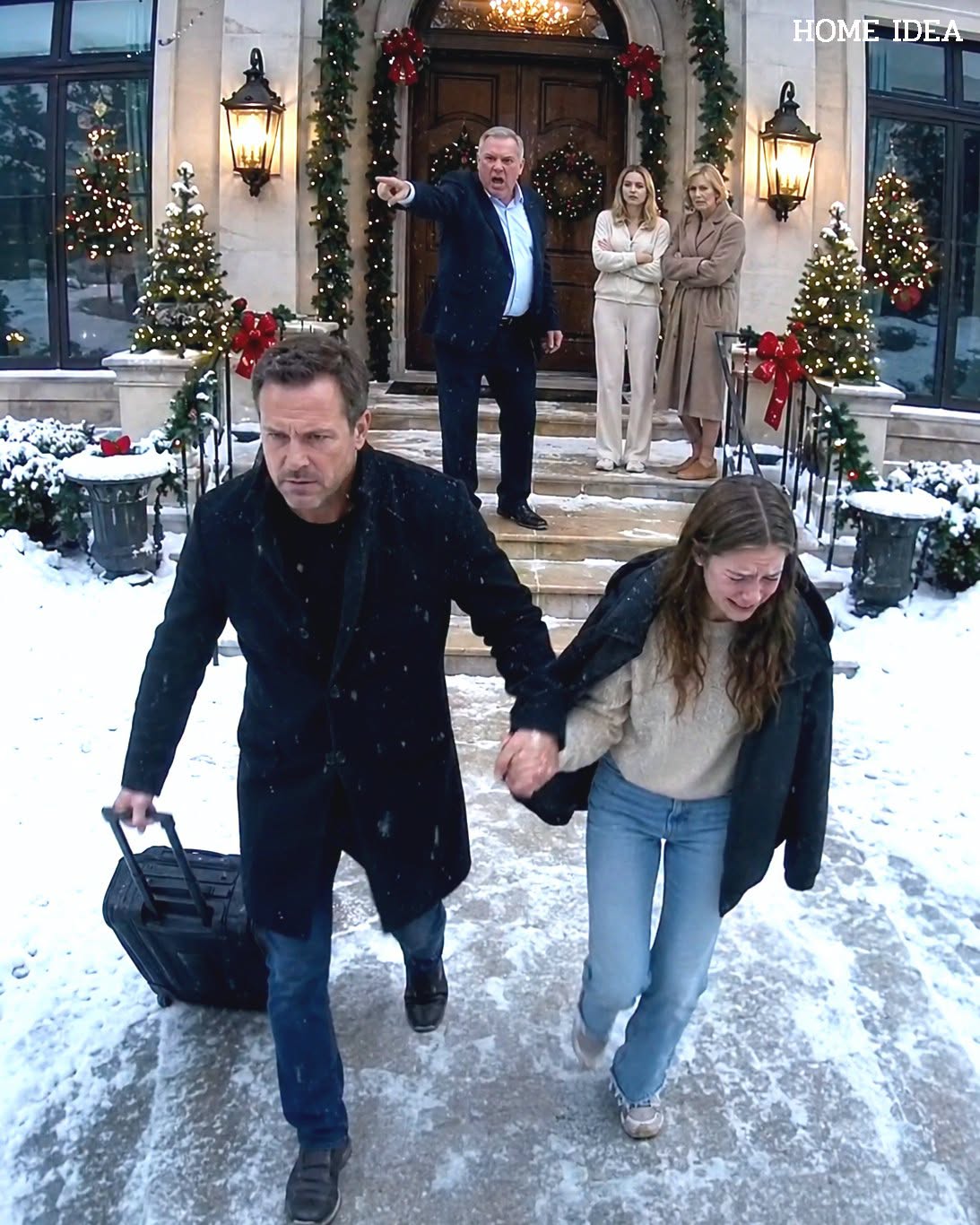
"My daughter was outside in the snow," I said quietly.
Claire looked away. "It's gotten out of hand."
"She didn't have a coat."
"She was disrespectful to my father."
"She is sixteen years old."
"She called him cruel."
"Was she wrong?"
Claire's eyes sparkled. For a second, the polished surface cracked.
"You can't understand what it's like to live in my family," she said.
"I have been married to your family for eight years."
"No. You were outside, judging."
I almost laughed. "They never let me in."
"Because you've never tried."
Those words were so absurd that for a moment I didn't know what to reply.
Claire's expression then changed. Her anger faded, giving way to a more desperate feeling.
"You can't fire them," she said.
And there you have it.
I felt no satisfaction. Only sadness.
"I haven't fired anyone."
"But you're going to do it."
"We are reassessing our positions."
"Daniel, my parents depend on these salaries."
"Your father earns two hundred and eighty thousand dollars a year as a regional development consultant."
"He works hard."
"He hasn't brought in a new client for eighteen months."
"He attends the meetings."
"He interrupts others during meetings."
Claire crossed her arms. "You approved her salary."
"Yes."
That stopped him for a moment.
I continued: "It's entirely my fault. I allowed my personal relationships to distort my professional decisions. I should have corrected that years ago."
His voice dropped. "Then correct him without humiliating my family."
"No one is humiliated."
"My father learned from Sophie that you are the owner of this place."
"Sophie discovered it last night too."
Claire flinched, barely.
I saw it.
For the first time since his arrival, I wondered if, beneath all this pride, there wasn't a feeling of guilt.
"Sophie deserves an apology," I said.
Claire looked over my shoulder towards the elevators. "Is she here?"
"Yes."
"I want to talk to him."
"Unless she wants it that way."
"I am his stepmother."
"You were."
It landed.
Her face paled.
"So that's it?" she asked. "Are you finished?"
"You handed me the divorce papers in front of your family."
"I was angry."
"You were ready. The documents were signed."
She swallowed.
"I didn't file them."
"No," I said. "You used them."
A heavy silence settled between us.
Then she said, in a softer voice, "Daniel, I didn't know Dad would throw her out."
"But you watched."
Her eyes suddenly filled with tears, but no tears fell.
"My father is difficult," she murmured.
"Your father is not the person I married."
"No," she said. "But he's the one who taught me what happens when you cross him."
For a moment the hall seemed still.
It was the first honest thing she had said all morning.
I waited.
Claire glanced down at her hands. Her wedding ring reflected the lights in the hall.
“When I was young, if you embarrassed him, he made sure you remembered it,” she said. “Not with bruises. Not like that. But with silence. Money. Approval. He could paralyze a room for weeks. He could make everyone act like you were gone when you were right there.”
I thought back to the Collins family table. To the way everyone looked at Martin before bursting into laughter.
"So why did you let him do that to Sophie?"
Her chin trembled. "Because I became a coward in this house."
It would have been easier for her to remain cruel.
I didn't have a suitable place to store his honesty.
"I understand the fear," I said. "I even understand old habits. But Sophie stayed outside, alone."
Claire nodded once, looking tense.
"Will you allow me to apologize to him?"
"I'll ask him."
"Today?"
"When it's ready."
Claire looked at the company sign again, then looked at me.
"What will happen now?"
"I'm taking care of my daughter. I'm consulting a lawyer. I'm letting Margaret and an outside advisor examine the personnel issue. And it's in her father's absence that one decides who one is."
Her gaze hardened at the mention of Margaret. She had always hated Margaret, even though she claimed otherwise.
"You were waiting for this," she said.
"No," I replied. "That's the worst part. I wasn't."
When Claire left, she didn't slam the door. She left carefully, as if dignity were a glass of water she couldn't afford to spill.
I found Sophie in the conference room with Margaret, eating a blueberry muffin and scrolling through her phone. She looked up abruptly.
"Was that Claire?"
"Yes."
"What did she want?"
"To talk to you."
Sophie's face closed up.
"You don't have to," I said.
"I know."
But I could see that she didn't know anything about it. Not completely. Children from complex families often believe that every adult emotion is somehow their responsibility.
"She said she wanted to apologize," I added.
Sophie stared at the table.
"Do you believe her?"
I thought about it carefully.
"I think she's feeling unwell. I don't know yet if she understands why."
Sophie nodded. "That seems right to me."
Margaret apologized and left us alone.
Outside, the snow continued to fall, blanketing the industrial area in white. The conference room smelled faintly of coffee and whiteboard markers. A plastic reindeer, its red nose flashing every few seconds, had been left near the speaker.
Sophie touched the edge of her muffin packaging.
"Are they all going to lose their jobs because of me?"
"No."
"But because of what happened."
"Because of decisions I should have made long before last night."
She seemed skeptical.
I pulled the chair next to her.
"I want you to understand this. You are not responsible for the consequences of the adults' work. You didn't hire them. You didn't set their wages. You didn't ignore their performance reviews. And you are not responsible for their actions."
Her mouth twisted as she tried not to cry.
"I just defended you."
"I know."
“At first, I wasn’t even rude. Grandpa Martin made a joke about your truck, and everyone laughed. I said it was a good truck. Then Austin said it was probably worth less than his watch. I said at least you earned it. And then…” She wiped her face. “And then, nobody was quiet anymore.”
I could perfectly picture it. Martin Collins, sporting that slow, menacing smile he displayed whenever a smaller person challenged him.
"What did he say?"
Sophie shook her head.
"You can tell me."
"He said I had the same illness as you."
"My illness?"
"Thinking that dignity allows you to pay the bills."
I closed my eyes.
"And I said that maybe it should."
My daughter. My calm and sweet daughter.
A laugh escaped me, not because it was funny, but because she had said in six words what I hadn't been able to say in eight years.
Sophie seemed worried. "Are you crazy?"
"No," I said. "I'm proud of you."
His face tensed again.
This time, when I hugged her, she held on tight.
The staff review lasted three days.
Three long days, cautious and painfully sober.
There were no formal speeches in the boardroom. No security escort. No names read aloud to a crowd. I hired an employment lawyer, Priya Sethi, who had the calmest voice I've ever heard and an uncanny ability to detect risk in a sentence before it was even finished.
We examined the files until our eyes burned.
Some members of the Collins family stayed.
Natalie Collins, the supplier compliance manager in Louisville, had excellent performance reviews and had saved the company nearly $400,000 through renegotiated supply contracts. She kept her job and received a note from Margaret thanking her for her work.
Evan Price, Linda's nephew, was a project coordinator in Cincinnati. Young, nervous, and overqualified for the family dramas surrounding him, he saw his superior write: "It's thanks to Evan that the West Chester construction projects were completed on time." And he stayed.
But most of the files told a different story.
There were people whose titles overlapped with those of three existing departments. People who hadn't met their performance targets for years. People who charged their personal travel to company accounts and labeled it as training. People whose superiors had begged for permission to discipline them, and to whom I had replied, "Please wait."
By the third morning, I was no longer angry.
I was ashamed.
Margaret noticed it.
"You've built a good company, Daniel," she said as we sat in the main conference room, surrounded by files. "Don't confuse the unfortunate exceptions with the overall structure."
"I let the exceptions become the norm."
"For a family," she said. "And now you're fixing that."
Priya glanced over her glasses. "Rightly so, I hope."
"Yes," I said. "Quite rightly."
In the end, forty-seven letters were sent.
But it wasn't just about dismissal letters.
That was the detail that Martin would never understand, because indignation prefers simple calculations.
Seventeen dismissals were immediate, for gross misconduct or job elimination, with severance pay. Eleven resulted in job elimination after a transition period. Eight were subject to performance improvement plans. Six involved notices of salary restructuring related to the duties performed. Five confirmed job retention with a hierarchical restructuring, as members of the same family were no longer responsible for mutual supervision.
Each letter was examined.
Every decision is recorded.
Each person was offered a private meeting.
No one was summoned into a room to be humiliated. No one was ridiculed. No one was forced to go live with a loser.
However, from ten o'clock in the morning, the phones began to ring as if a storm had hit the building.
Martin called first.
I let the message go to voicemail.
Then Austin.
Then Reid.
Then Linda.
Then Claire.
Then Martin again.
At noon, Margaret came into my office and closed the door.
"You have to see this."
She handed me a tablet.
The image showed a post by Linda Collins on social media: a photo of her Christmas tree accompanied by a long caption evoking betrayal, greed and "some people who forget where they came from".
My name was not mentioned.
It wasn't necessary.
Comments have already come in from cousins and friends, most of them indignant, a few perplexed, one of them asking if this was about "Whitaker".
I returned the tablet.
"Should we respond?"
"No," Margaret replied. "But you should know that."
My phone vibrated again.
This time, it was a text message from Claire.
Please call me. Not about them. About Sophie.
I stared at her for a long time.
Then I called.
Claire replied immediately: "Daniel."
"And Sophie?"
"She's not responding to my messages."
"She doesn't owe you that."
"I know." Her voice was different. Tired. Weaker. "I wrote her an apology, but I don't know if I should send it."
"Why are you asking me this question?"
"Because I don't trust myself to choose the right person."
That silenced me.
Outside my office, employees walked confidently along the glass walls, as if trying not to appear curious.
"Read it," I said.
Claire took a deep breath, her voice trembling.
“Sophie, I’m sorry about what happened on Christmas Eve. I should have protected you. I shouldn’t have stayed silent when my father told you to leave. I was wrong. You didn’t deserve to be treated like that, and you’re not responsible for the conflict that followed. I understand if you don’t want to talk to me. I just wanted you to know that I’m sorry.”
I waited.
"Is that all?" I asked.
"Yes."
No apology. No mention of embarrassment. No request for forgiveness.
"Send it," I said.
"She might hate me."
"It's possible."
Claire remained silent.
Then she whispered, "Really?"
I looked at the framed photo of Sophie painting while wearing safety glasses.
"I don't know how I feel yet."
"That's right."
The call should have ended there, but neither of us hung up.
Finally, Claire said, "My father is coming to your office."
"When?"
"I don't know. Soon. He left in anger."
" Clear. "
"He discovered that his consulting contract had been terminated for gross misconduct."
"It was."
"He says he has files."
A shiver ran through me, subtle but very real.
"Which records?"
"I don't know. He said you'd regret making him seem insignificant."
I got up slowly.
"Claire, listen carefully. Has your father ever asked you to sign anything related to the company?"
"No."
"Has he ever discussed the company's finances at home?"
"All the time. Especially to brag."
"About what?"
She hesitated.
"Daniel, there's something I haven't told you because I thought it was just Dad talking."
"What?"
"He said the company owed him money."
I gripped the phone in my hand.
"For what?"
"For having remained silent."
My office seemed to be shrinking.
"When did he say that?"
"A few times over the years. Usually after drinking. I thought he meant that we had to keep it a secret from the family once he found out."
I turned towards the window.
The snow was now melting on the parking lot, revealing the dark, wet asphalt under a pale winter sun.
"Claire," I said very slowly, "at what point do you think your father understood?"
"I don't know. Maybe last year?"
I was thinking back to Martin's wry smiles. His jokes. His ease in the office. The way certain invoices had been defended too vehemently by people who shouldn't have cared about them.
I had a knot in my stomach.
"Daniel?"
"I have to go."
"Is Sophie alright?"
"She is with me."
"Tell him I sent that message because I truly meant it."
"I'll tell him that you sent him."
I hung up and immediately called Margaret.
"Remove all supplier contracts in which Martin participated."
She didn't ask why. "Until when?"